
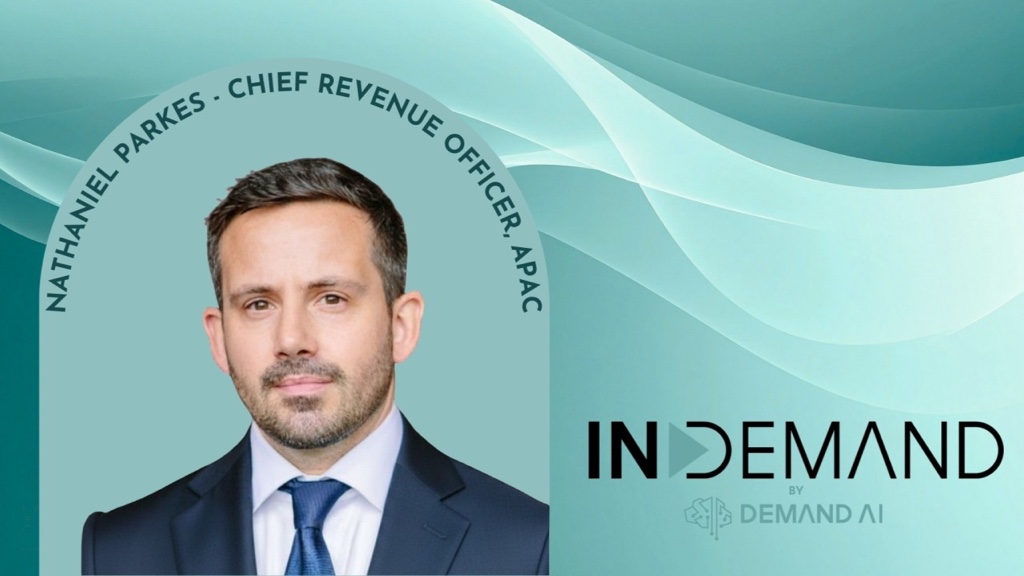
Nathaniel Parkes, Chief Revenue Officer — Australia, Demand AI
If you spend enough time around B2B marketing, you could be forgiven for thinking AI has already solved everything.
Every platform is 'AI-powered'. Every presentation promises transformation. Every vendor claims automation, personalisation, optimisation, acceleration — usually all at once.
But when I sit down with marketing leaders across Australia, the conversations are far more grounded.
They're not asking, "How do we use AI because everyone else is?" They're asking:
- Will this improve performance?
- Will it help us prove ROI?
- Will it help us better understand buyers?
- Or is this just another layer of complexity?
That distinction matters because the gap between AI hype and AI reality is where many marketers are currently operating.
Pressure on marketers
Australian marketers are under enormous pressure to do more with less.
Content demands are exploding. Research suggests Australian marketing teams expect content requirements to increase dramatically over the next two years, while simultaneously being asked to deliver more personalised customer experiences at scale.
At the same time, marketing is now deeply accountable to revenue. Every investment needs to show measurable business impact. Every campaign needs attribution. And increasingly, every technology decision needs a clear commercial outcome attached to it.
That's why AI adoption has accelerated so quickly. Research shows that 95% of B2B organisations are already using — or planning to use — AI tools by the end of 2025. But adoption alone is not success.
What AI is good at
In my view, AI is proving genuinely valuable in three areas.
First: removing operational friction. Marketers are using AI to automate repetitive downstream tasks — production, formatting, translation, summarisation, analytics — freeing teams to spend more time on strategy and creativity. Leading B2B marketers are increasingly using AI to accelerate workflows and deliver measurable engagement outcomes.
Second: improving access to insight. The biggest challenge in B2B marketing has never been lack of data. It has been lack of clarity. Most organisations are drowning in signals but struggling to identify genuine buyer intent. AI is finally helping marketers analyse engagement patterns, surface behavioural insights, and understand what buyers care about — not just what they clicked on.
Third: enabling personalisation at scale. For years, hyper-personalisation sounded great in theory but collapsed operationally. AI is making it possible to tailor journeys, messaging, and content experiences without multiplying headcount or complexity. That is real progress.
Where the industry is getting it wrong
Where I think the market gets distracted is treating AI as the strategy itself. It isn't. AI is infrastructure.
The goal is still the same as it has always been: build trust, engage buyers, and drive commercial outcomes. And ironically, as AI becomes more common, trust becomes even more important.
Recent research shows deep public scepticism toward AI, with concerns centred around transparency, governance, and authenticity. That matters for marketers, because buyers are becoming increasingly sensitive to experiences that feel synthetic, generic, or purely automated.
The future is not 'AI replacing marketing'. The future is marketers using AI intelligently to create more relevant, more human, and more valuable experiences.
What comes next
I think we're entering a new phase of B2B marketing in Australia. One where the winners won't necessarily be the organisations using the most AI — but the ones using it most credibly.
The companies that succeed will be the ones that:
- connect AI to measurable ROI,
- use data responsibly and transparently,
- understand genuine buyer intent,
- and combine automation with authentic human engagement.
That's the difference between hype and reality. And frankly, that's where the real opportunity starts.
This article was first published in Demand AI’s In Demand newsletter on LinkedIn. Talk to Demand AI about how we can help.