
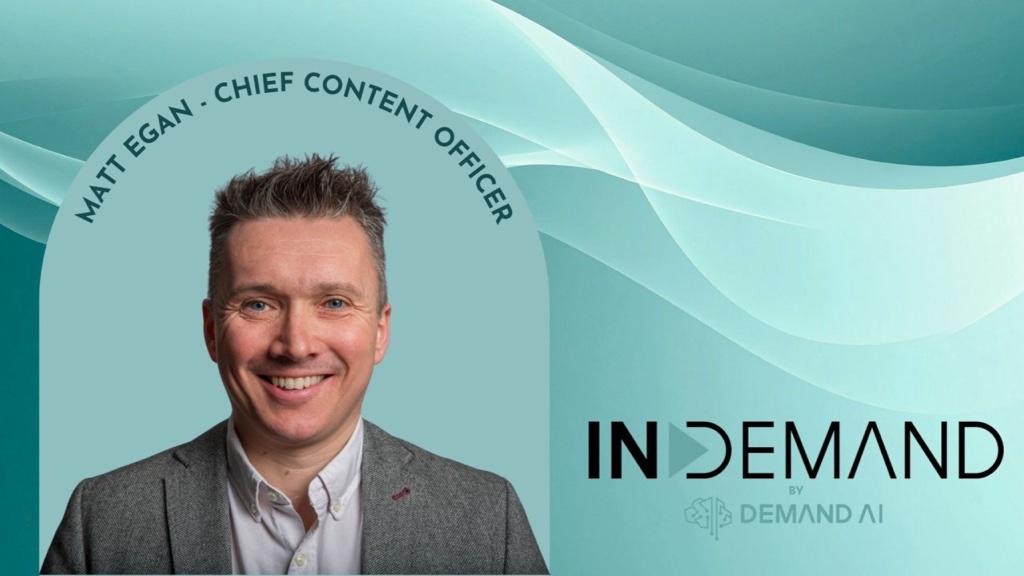
Matt Egan, Chief Content Officer, Demand AI
Recently I had the privilege of hosting a session at B2B Ignite London — a conversation I'd been looking forward to for months. Not because I had a polished narrative to deliver, but because the questions it was built around feel urgent: how is AI transforming B2B marketing strategy? Where is it creating real value? And what are we still getting wrong?
Here is my attempt to capture the thinking from that session — the research, the frameworks, and the conclusions that matter the most for B2B marketers heading into the rest of 2026.
How deep, how fast, and how to prove it
For the past few years, AI in B2B marketing has been framed as an experiment. AI was something forward-thinking teams were piloting, and the rest were watching. That framing is now outdated.
The data from 2026 tells a different story:
- 89% of B2B buyers now use GenAI during the buying process (Forrester, 2026)
- 76% of marketing teams are using AI in core operations today (IBM Global AI Index)
- AI content drafting delivers a 3.2x ROI versus traditional methods (McKinsey Global AI Survey)
The conversation has shifted. It's no longer if. It's how deep, how fast, and how to prove it.
The buyer has already changed
This moment is different from previous waves of marketing technology: the change is happening on the buyer side, not just the vendor side.
B2B purchases now involve an average of 13 stakeholders (Forrester). 61% of B2B buyers prefer a rep-free experience for at least part of the journey (Gartner). And vendors only get 17% of the buyer's time — the rest is spent on independent digital research.
But the most significant shift? GenAI chatbots are now the number one source influencing B2B vendor shortlists — ahead of vendor websites and peer referrals, according to 6sense's B2B Buying Statistics 2026. And 94% of B2B buyers used LLMs during their most recent purchase process.
Let that land for a moment. The shortlist — the single most important moment in the B2B buying journey — is increasingly being shaped by AI, not sales reps or content marketers. By 2026, Forrester predicts that at least one in five B2B sellers will be responding to AI-powered buyer agents with AI-driven counter offers.
If your content isn't optimised for how AI systems discover and evaluate vendors, you are already invisible to a significant portion of your addressable market.
Where AI is delivering tangible results
The interesting question for practitioners isn't whether AI works — the research is clear that it does. The question is where to deploy it for maximum impact.
Six areas are consistently delivering measurable results in B2B right now:
Data and insights — AI-driven campaigns generate 22% higher ROI than traditional approaches (McKinsey). The ability to synthesise intent signals, firmographic data, and behavioural patterns at scale is creating a genuine edge for teams that invest in this properly.
Content at scale — The 3.2x ROI figure for AI content drafting (McKinsey) is the one I come back to most often. It's not about replacing writers. Content must start from relevant human insight, and requires human oversight. But a creative and skilled content creator working with strong editorial governance can dramatically increase output velocity while maintaining quality. If you are not using it, you should be.
Hyper-personalisation — A 15-25% conversion rate lift from AI personalisation (Salesforce) is significant. But note that Gartner research suggests that 53% of B2B buyers have experienced negative outcomes from poor personalisation — and are 3.2x more likely to regret the purchase as a result. Personalisation done badly is worse than none at all.
Marketing automation — Marketers are saving an average of six hours per week through AI-assisted automation (HubSpot, 2026). Across a team, this compounds into a meaningful strategic resource.
Predictive intent — AI-driven campaigns are generating 32% more conversions through better intent prediction and campaign optimisation (McKinsey). The ability to reach the right buyer at the right moment in their research journey is becoming a core competency.
Proving ROI — Customer acquisition costs are 29% lower with AI (McKinsey). For marketing leaders under pressure to justify budgets, this is the number that tends to get attention in the boardroom.
What to automate, and what to keep human
This is where the most nuanced thinking is required, and where a lot of teams are getting it wrong, in both directions.
Some are automating things they shouldn't. Others are holding on to manual processes that AI could handle better, faster, and cheaper. Neither serves the business.
Here's how I think about the divide:
Automate with AI
- Routine data processing and cleansing
- Lead scoring and intent signals
- Content drafting and first versions
- Email sequencing and nurture flows
- Campaign optimisation and bid management
- Reporting and performance dashboards
Keep human
- Strategic positioning and brand voice
- Complex stakeholder relationships
- Creative ideation and genuinely original ideas
- Sensitive client communications
- Ethical governance and AI oversight
- Final editorial judgement on content
The human side of this list isn't about what AI can't do — it's about what it shouldn't do. Or at least, what it should not be trusted to handle without meaningful human oversight. The moments that define brand trust, creative differentiation, and strategic positioning are not places to cut corners in the name of efficiency.
Governance is the new competitive advantage
This is the most underrated point in the entire AI conversation.
AI adoption in marketing is accelerating fast — from 29% of teams using AI in core operations in 2021, to 76% today. But governance is not keeping pace:
- $10B+ in enterprise value is at risk from ungoverned GenAI use in 2026 (Forrester 2026 Predictions)
- 19% of buyers feel less confident in their decisions due to inaccurate AI output (Forrester 2026)
- 70% of marketers receive no AI training from their employers (Salesforce)
- 68% of enterprise buyers now factor AI governance into vendor selection (Forrester 2026)
That last figure should be getting more attention. If more than two-thirds of enterprise buyers are evaluating AI governance as part of their vendor assessment, then your approach to AI is no longer just an internal operational question — it's a commercial one.
The organisations that will win this decade won't necessarily be those who adopted AI fastest. They'll be those who governed it best.
Where to go from here
If I were to distil everything into a set of practical starting points, it would be these:
- Treat discoverability as a strategic priority — If 89% of buyers are using GenAI in their research, your content needs to be optimised for how AI systems surface and evaluate information, not just how Google indexes it. You are everything you put on the internet.
- Start with the high-ROI use cases — Content drafting and personalisation are where the evidence is strongest. Start there, measure rigorously, and build the business case from real results.
- Make the automate/human decision deliberately — Don't let it happen by default. Define clearly what AI handles, what humans own, and where the handoffs are.
- Build governance before you need it — The instinct is to move fast and figure out governance later. The evidence suggests that approach carries commercial risk. Build the framework now.
- Pilot, measure, prove, then scale — The teams getting the best results are moving methodically, proving value at small scale before committing at volume.
AI is no longer something B2B marketers are watching from the sidelines. It's operational, it's measurable, and the gap between those who are using it well and those who aren't is widening by the quarter.
The good news is that the playbook is becoming clearer. The research is accumulating. The early movers have made enough mistakes that the rest of us can learn from them.
The question now is simply whether you act on it.
This article was first published in Demand AI’s In Demand newsletter on LinkedIn. Talk to Demand AI about how we can help.