
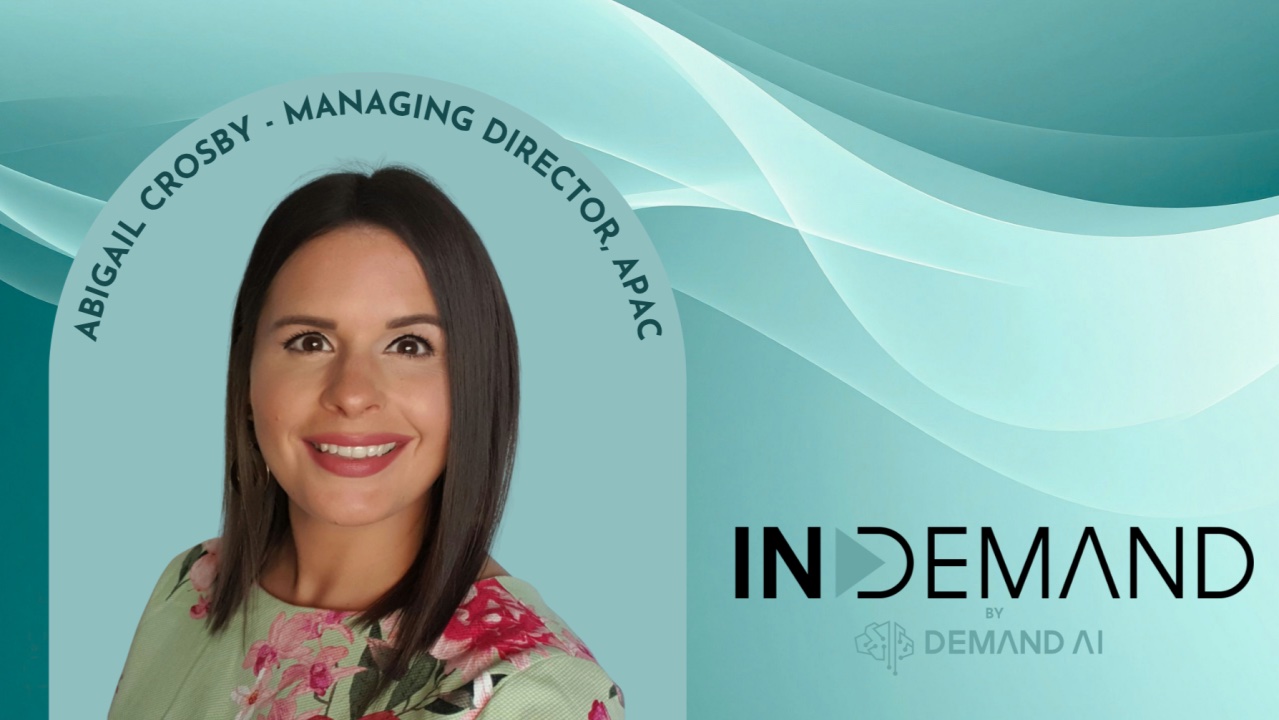
Abigail Crosby, Managing Director, APAC, Demand AI
There’s a question every leader should be asking themselves as AI becomes part of everyday business: Am I using AI to bring my vision to life, or is AI setting the vision for me?
It was one of the questions at the heart of my discussion with David Dahan of Ogilvy/WPP at IAA Talks: AI | Practical Magic in Singapore. Our conversation explored leadership and judgment in the age of AI, and the importance of keeping people at the centre of an increasingly technology-driven world.
We Decide, AI Does
For me, it comes down to a simple distinction. AI can help us do better work. But it is still our responsibility to decide what that work should be, why it matters and where we want it to take us.
That distinction is becoming increasingly important.
AI gives us access to extraordinary capabilities. We can process information faster, explore more possibilities, automate repetitive tasks and make better use of our time. It can help us see patterns we might otherwise miss and give our teams the tools to achieve more.
But there’s a risk in assuming that because a tool makes something faster, it automatically makes it better.
Are we becoming more informed, or simply more reliant on technology to tell us what to think? Are we making better decisions, or just making them faster?
And, as AI becomes increasingly embedded in our working lives, how do we ensure that we don’t lose the creativity, intuition and independent thinking that make leadership valuable in the first place?
If we rely on AI to generate every idea, answer every question and guide every decision, what happens to our own ability to think critically? Are we using technology to expand our thinking, or gradually outsourcing it?
The Judgment Call
As leaders, we need to be comfortable with AI while remaining confident in our own judgment. That means knowing when to use it, when to challenge its output and, perhaps most importantly, when to ignore it.
The role of leadership isn’t to have all the answers. It’s to ask the right questions, set a direction and give people the confidence to move forward. AI can support that process, but it cannot replace the responsibility that comes with it.
This is also how we should approach AI in business more broadly. Too often, conversations start with the technology: What can we automate? What can we generate? What can we do faster?
Those are useful questions, but they aren’t the starting point.
Solving Real Problems
At Demand AI, we build AI tools to solve real problems for B2B marketers. We don’t begin with a technology and look for a reason to use it. We start by understanding the challenges marketers face and the outcomes they need to achieve.
Take B2B demand generation. The challenge isn’t simply producing more content or generating more leads. It’s understanding buyers: what they care about, what questions they have and how businesses can engage with them in ways that are genuinely useful.
Our approach is to use AI to help marketers listen to buyers, understand their interests and deliver more relevant experiences at scale. The technology makes that possible quickly and consistently. But the thinking behind it — identifying the problem and deciding what meaningful engagement looks like — comes first.
That is what I mean by starting from first principles. It’s not about asking what AI can do and finding a way to apply it. It’s about asking what needs to be done, then working out how AI can help us do it better.
For leaders, the same principle applies. We should be ambitious about what AI can help us achieve, but clear about the values, strategy and vision that guide us.
Better Tools
The opportunity is not to hand over leadership to technology. It is to give people better tools to lead.
And perhaps the real measure of successful AI adoption is not how much of our work we have automated, but how much more meaningful, creative and valuable our work has become as a result.
That’s the practical magic of AI: when the technology works so well in the background that people can focus on what really matters.
IAA Talks: AI | Practical Magic brought together leaders from across the industry to explore the realities of AI adoption, transformation and leadership. I was delighted to contribute to that conversation and to explore a question that will only become more important as the technology evolves: how do we make AI work for us, without losing what makes us human?
Find out more about Demand AI.